
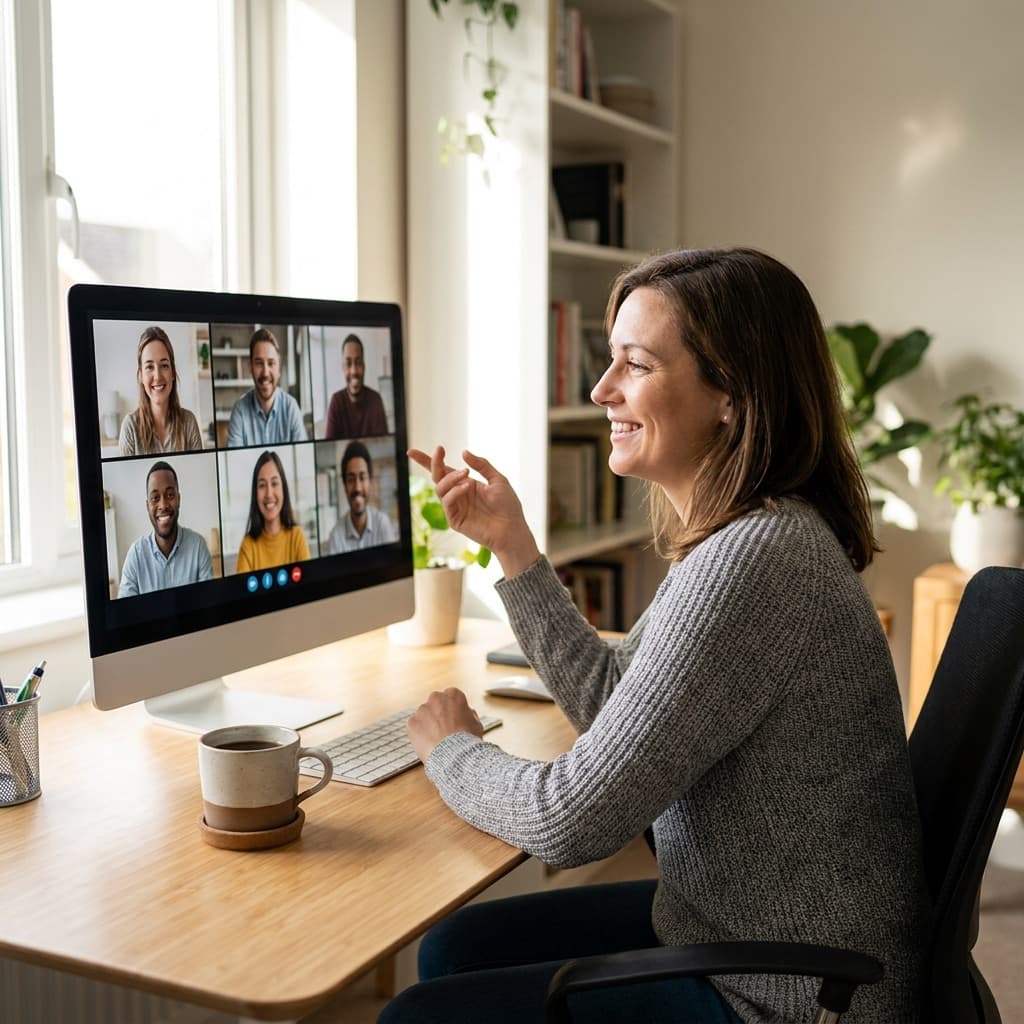
What Team Building Activities for Remote Teams Actually Build Culture?
Remote culture isn't built by a monthly Zoom happy hour — it's built through consistent small moments. Run daily async check-ins, weekly low-effort touchpoints (shared playlists, photo prompts), and one optional monthly live session or virtual experience. The system matters more than any single activity.
In this playbook
Jump to any section
Morning Signal
A daily async check-in: each person drops a one-liner in a shared channel — what they're working on, how they're feeling, or a GIF that matches their mood. No replies required. Takes 10 seconds and recreates the 'seeing teammates arrive' moment remote workers miss. Over a week, these micro-signals build a real sense of shared rhythm.
Weekly Playlist Swap
Every Monday, someone shares a playlist — work music, a mood-based pick, or a genre they love. Others listen and react throughout the week. Async, timezone-proof, and it reveals personality in a way tasks never will. By month 3 you'll have a library of team playlists that become real shared references.
Virtual Coffee Roulette
Every two weeks, randomly pair team members for a 20-minute video chat. No agenda — just talk. Pairs shuffle each round so everyone meets everyone eventually. Optional: share one fun fact from your chat in the team channel afterward. It's the remote equivalent of bumping into someone in the kitchen.
The Signal-Rhythm-Event Stack
Remote teams don't lack tools — they lack ambient awareness of each other. In an office you absorb social info passively: who's stressed, who brought a great lunch. Remote teams must create this intentionally. The Signal-Rhythm-Event Stack builds three layers of connection at different frequencies — daily signals (I see you), weekly rhythms (I know you), and monthly events (I've experienced something with you). Teams running all three layers report feeling as connected as co-located teams within 10 weeks.
Show the framework behind these picks
Signals
Tiny async check-ins: morning status posts, mood GIFs, 'what I'm listening to' shares. Signals take 10-30 seconds and serve one purpose — making teammates visible to each other. Without daily signals, remote workers operate in isolation between meetings.
Rhythms
Low-effort recurring touchpoints: playlist swaps, photo challenges, question-of-the-week threads. Rhythms take 5-10 minutes and create shared references — the song someone recommended, the recipe someone tried, the hobby someone revealed. These become the 'watercooler' of remote work.
Events
One optional synchronous or semi-synchronous experience: virtual trivia, coffee roulette pairs, show-and-tell. Events take 20-30 minutes and create shared memories — the moment [Name] won trivia with an absurd answer, the time [Name] showed their pet on camera. These become team lore.
4-Week Plan: Building Remote Team Culture From Scratch
Layer connection from lightweight to immersive. By week 4 your remote team has a culture stack that mostly runs itself.
Start the Daily Signal (Week 1)
Monday morningCreate a #morning-signal channel (or use your existing social channel). Post the format: every morning, drop a one-liner — what you're working on, your mood, or just a GIF. No replies expected. Lead by example and post every morning for the first week. Within 3-4 days others will start without prompting — the channel creates a gentle social pull.
Hey everyone — trying something new: #morning-signal. Every morning, just drop a quick one-liner. What you're working on, how you're feeling, a GIF — anything. No replies needed, it's just a way to 'see' each other at the start of the day. I'll kick it off right now: [your morning signal]. Who's joining me tomorrow?
Don't overthink your posts. 'Tired but caffeinated. Working on the proposal. 🎵 listening to jazz' is perfect. The more casual you are, the more others will be.
Add the Weekly Rhythm (Week 2)
MondayKeep the daily signal going — it should be self-sustaining by now. Add the Playlist Swap: every Monday, one person shares a playlist. Create a rotation so people know their week in advance. Others listen and drop reactions throughout the week. This is intentionally low-effort — shared experiences happening in the background of the workday, not a scheduled event.
🎵 Playlist of the Week Every Monday, one of us shares what we're listening to. Listen during the week, drop a reaction or comment in the thread. Schedule: Week 1: [Name] Week 2: [Name] Week 3: [Name] Week 4: [Name] Genre, mood, theme — totally your call. Kicking us off: [Name] — [Playlist link]. Go give it a listen.
Add a second weekly rhythm in week 3 or 4 if the first sticks — a photo challenge, a book rec, or a recipe swap. Don't rush it.
Run the First Monthly Event (Week 3)
Pick the overlap window for most time zonesRun your first Virtual Coffee Roulette: randomly pair everyone for 20-minute video chats. Post pairs in the channel and let people schedule their own chat within the week. No agenda — just get to know each other. Alternatively, run a 20-minute group activity like team trivia or show-and-tell. The event layer creates shared stories that signals and rhythms can't — a memory of an experience, not just an exchange of information.
☕ Coffee Roulette — [Month] I randomly paired everyone for a 20-min video chat this week. No agenda — just hang out. Pairs: • [Name] + [Name] • [Name] + [Name] • [Name] + [Name] Schedule it whenever works for both of you. If timezones make a call tricky, async voice messages work great too. Bonus points if you share one fun fact from your chat in #team-social. New pairs next month!
If your team spans very different time zones, allow async alternatives — voice messages, a shared doc of questions and answers, or a short video recorded for each other.
Complete the Stack (Week 4)
End of monthYou now have all three layers: Daily Signals, Weekly Rhythms (playlist swap), and Monthly Events (coffee roulette). Automate what you can — recurring Slack posts, randomized coffee pairs, playlist rotation schedule. Take a quick pulse: ask the team what's working and what isn't. Adjust, but don't overhaul. The system needs 6-8 weeks of consistency before it becomes cultural muscle memory.
If you're using Actify, the entire Signal-Rhythm-Event Stack can be configured in one session — automated morning prompts, rotating weekly challenges, and randomized coffee pairings with scheduling built in.
What Not to Do
We've seen these patterns across hundreds of teams. Each one kills participation.
Only Doing Monthly Events and Nothing Else
A monthly virtual happy hour without daily signals or weekly rhythms is like seeing a friend once a month with no texting in between — the relationship never deepens. Remote culture is built in the small, frequent moments between events. Events are the capstone, not the foundation.
Teams running only monthly events report 2.9/5 on 'feeling connected to teammates.' Teams running the full Signal-Rhythm-Event Stack report 4.4/5 (Actify platform data, 2024, n=560 remote workers).
Making Everything Synchronous
If every activity requires everyone online at the same time, you're excluding people in inconvenient time zones and anyone with a schedule conflict. Make async the foundation — signals and rhythms. Synchronous events should be optional, once a month, well-timed, and always with an async alternative.
Sync-only remote programs see 40% participation from the 'convenient' timezone and 15% from everyone else. Async-first programs see balanced 55-65% participation across all regions.
Assuming Slack Messages Equal Connection
Work-related Slack messages don't build relationships. You can exchange 100 messages a day about tasks and still not know if a teammate has kids, what they do on weekends, or how they're really doing. Remote team building requires intentional non-work touchpoints — that's what signals and rhythms provide.
Teams with high Slack volume but no social rituals score 22% lower on belonging metrics than teams with moderate Slack volume and regular social touchpoints.
Treating Remote Team Building Like a Mandatory Program
The moment remote activities feel like an obligation, participation tanks. Frame everything as opt-in and low-pressure. Let people lurk in the morning channel before posting. Skip the formal rollout deck. The best remote culture programs feel like something people actually want to do, not an HR mandate.
Remote-native activities (async-first, short sync, shared experiences) achieve 61% sustained engagement. Transplanted in-person activities average 28% and declining.
Pick the Right Activity for Your Situation
Not every team is the same. Use this matrix to find what fits.
| If your team is… | Do this | Why it works | Time |
|---|---|---|---|
| Newly remote team (just went distributed) | Morning Signal + Coffee Roulette pairs | Replaces the two things they miss most: seeing each other arrive and casual kitchen chats | Week 1 |
| Team spans 3+ continents | Async-only signals and rhythms, monthly rotating-time event | No single time works for everyone; async ensures equal participation | Immediately |
| Team of 3-5 remote workers | Daily signal + weekly virtual coworking + biweekly group call | Small enough for everyone to be in every activity; coworking recreates shared space | Week 1 |
| Large remote team (30+ people) | Signal-Rhythm-Event Stack + department-level sub-groups for events | Full-team signals keep everyone visible; sub-groups make monthly events intimate enough to feel personal | Month 1 |
| Remote team with high turnover | Full Signal-Rhythm-Event Stack + new-hire buddy pairing | Turnover often signals disconnection; the full stack addresses belonging directly | This month |
| Leadership wants to see ROI | Start with free activities, measure for 8 weeks, present retention data | Signals and rhythms cost $0; coffee roulette costs $0. Measure before requesting budget | Month 1–2 |
Copy, Paste, Launch
Don't start from scratch. These templates have been tested across dozens of teams.
Morning Signal Channel Setup
📡 #morning-signal — here's how it works: Every morning, drop a one-liner. Your mood, what you're working on, a song, a GIF — whatever feels right. No replies needed (though always welcome). Keep it under 2 sentences. Post whenever your morning starts. A few examples to get the feel: • 'Coffee #2. Deep in the migration script. Actually enjoying it.' • 'Running late after school drop-off chaos. Online by 10.' • [GIF of a cat with coffee] That's it. See you tomorrow.
Pin this in the channel. Post every single day for the first 2 weeks — your consistency signals that this channel matters.
Coffee Roulette Pairing Script
☕ Coffee Roulette — [Month] Here's how it works: 1. I randomly paired everyone 2. Schedule a 20-min video chat with your pair this week — whenever works 3. No agenda. Talk about anything except work (unless it comes up) 4. Optional: drop a fun fact from your chat in #team-social This month's pairs: • [Name] + [Name] • [Name] + [Name] • [Name] + [Name] Timezone tricky? Async voice messages or a shared question doc work great. New pairs next month — over 6 months, everyone meets everyone.
Use a random generator or a tool like Donut for Slack. The randomness is the point — it creates connections that wouldn't happen organically.
Remote Culture Budget Proposal
Hi [Name], I want to pitch a small investment in our remote team culture — I think the ROI math is pretty compelling. Replacing one remote employee runs $20,000–$35,000 when you factor in recruiting, onboarding, and ramp-up time. What I'm proposing costs a fraction of that. Here's the plan: 1. Daily async signals — free, just a Slack channel 2. Weekly rhythms (playlists, photo prompts) — free 3. Monthly optional events: coffee roulette + one virtual experience — $10–15/person/month Total: $[X]/month for [N] remote employees. Expected outcome: 31% reduction in remote employee turnover (Buffer, 2024). 4.4/5 connectedness within 10 weeks. I'd run a 4-week pilot and report participation + engagement data monthly. Happy to walk through it — takes about 5 minutes.
Lead with the cost of losing one remote employee. That number makes $10-15/person/month feel like rounding error.
Monthly Remote Culture Report
📊 Remote Team Culture — [Month] Signals (Daily): • Avg daily posts in #morning-signal: [N] / [Team size] • Most active day: [Day] Rhythms (Weekly): • Playlist engagement: [N] listeners/reactions • Prompt threads: [N] unique contributors Events (Monthly): • Coffee roulette pairs completed: [N] / [Total] • Group event attendance: [N] ([X]%) Overall: • Connectedness score: [X]/5 (last month: [Y]/5) • Remote retention: [X]% (company avg: [Y]%) What's working: [One sentence] Next month: [Planned tweak or new activity] Cost: $[X] total ($[Y]/person/month)
Track the connectedness score monthly. Seeing it climb from 2.9 to 4.4 over 10 weeks is the most compelling story for leadership.
What to Expect When You Run This Playbook
4.4/5
Connectedness score with full Signal-Rhythm-Event Stack
31%
Reduction in remote employee voluntary turnover
$3.60
Cost per remote employee per month
10 wks
Time to match co-located team connectedness
Based on aggregated data from teams using Actify. Individual results may vary.
Frequently Asked Questions
What Team Building Actually Looks Like
Not trust falls. Not forced fun. Real activities that people actually want to do.



Explore More Team Building Guides
Skip the Setup. Run This Playbook on Actify.
Actify handles scheduling, tracking participation, rewards, and reporting — so you can focus on your team, not logistics.