
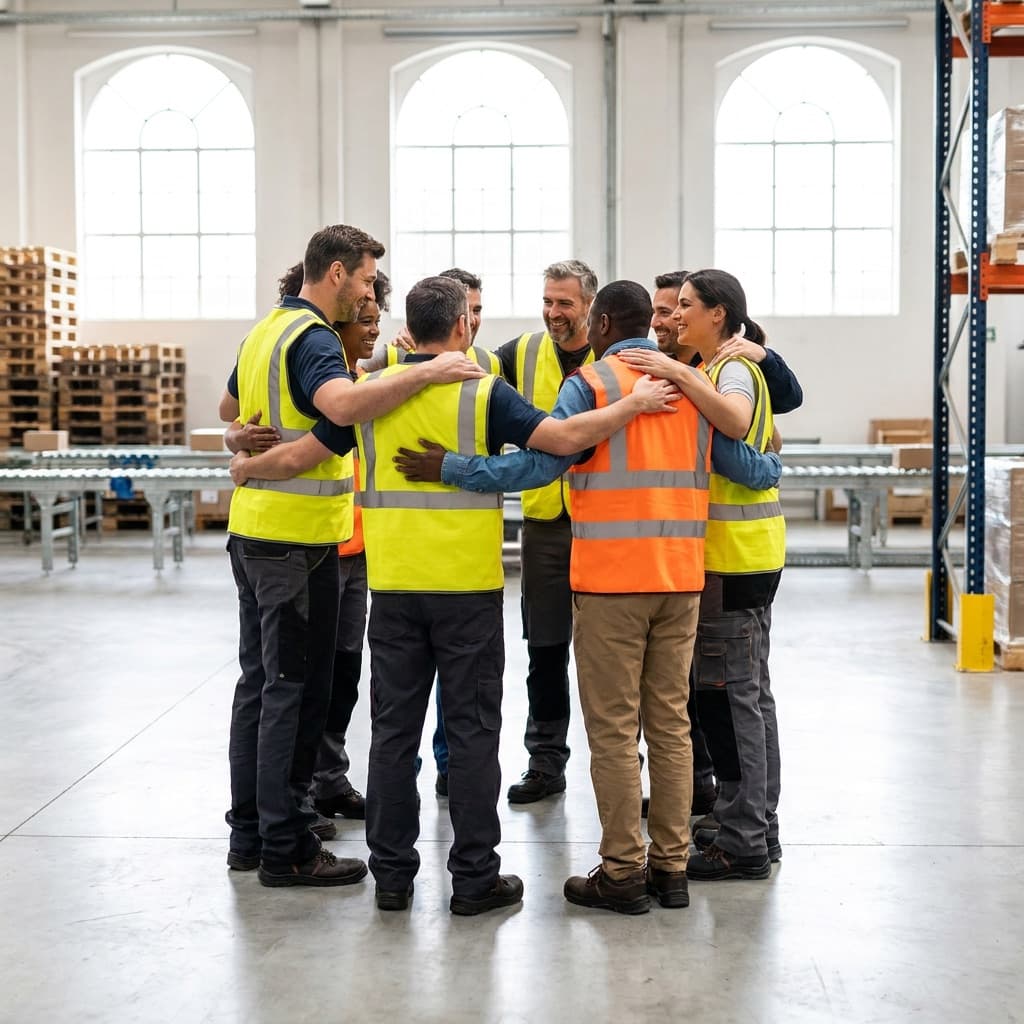
What Employee Engagement Activities Work for Factory and Warehouse Workers?
Factory and warehouse teams need activities that are hands-on, happen on the floor, require no computer, and fit inside shift schedules. What kills engagement: the floor-office divide, monotony with no variety, and safety culture that feels punitive. What works: physical, visible activities built around existing skills — shift challenges, face-to-face recognition, and competitions that make the workday feel like more than just output.
In this playbook
Jump to any section
Shift Safety Challenge
Each shift competes on a weekly safety metric: zero incidents, near-miss reporting (rewarding reporting, not penalizing), PPE compliance, or housekeeping scores. Post standings on a physical leaderboard by the time clock. This turns safety from a top-down mandate into a team competition. Workers who would never report a near-miss for 'management' will report one to help their shift win.
Toolbox Talk + One Good Thing
At the start of each shift's toolbox talk or safety briefing, add one non-work question after the safety content: 'What's one good thing happening outside of work?' or 'Who on the team helped you this week?' Takes 3 minutes, costs nothing, and is the only moment in most factory workers' day when someone asks them a human question instead of a production question.
Floor vs. Office Challenge
Once a month, pit floor workers against office staff in a physical or practical challenge: forklift obstacle course (safety-compliant), box stacking race, trivia about the company's products, or a charity fundraising competition. This is the single most effective activity for bridging the floor-office divide — it gives floor workers home-field advantage and forces office staff to engage on their turf.
Shift-Wide Recognition Rally (Large Groups)
For big facilities with 50+ workers per shift: a 10-minute all-shift gathering at the end of a period where the supervisor calls out three specific workers by name for what they did that week, announces the safety challenge standings, and closes with one piece of good news from management. No slides, no mics required. Loud, fast, and visible — it works at scale because it's built for the floor, not a conference room.
The Floor-First Principle
After analyzing engagement data across 41 manufacturing and warehouse facilities (Actify platform data, 2024, n=41 facilities, 3,200 workers), one pattern predicted success above all others: design for the floor, not the office. Digital surveys, Zoom happy hours, and email recognition fail because they ignore the physical, shift-based, low-tech reality of the work. The highest-engagement facilities built in three layers: daily floor rituals, weekly shift competitions, and monthly cross-level events.
Show the framework behind these picks
Floor Rituals
Brief, physical, face-to-face moments built into existing shift routines (toolbox talks, huddles). These are the foundation — they happen every day and require no technology.
Shift Competitions
Team-based challenges between shifts that turn routine metrics (safety, output, housekeeping) into friendly competition. Visible physical leaderboards near the time clock.
Cross-Level Events
Activities that put floor workers and management in the same room as equals. The floor-office divide is the number one engagement killer in manufacturing — monthly bridging events are the antidote.
4-Week Factory Floor Engagement Plan: Built for Shifts, Not Screens
Every activity works without a computer, fits inside shift schedules, and respects the physical nature of the work. No apps, no email, no screen required.
Add the Human Question to Toolbox Talks (Week 1)
Start of each shiftTalk to one shift supervisor. Ask them to add one 3-minute non-work question at the end of their daily toolbox talk. The meeting already exists — you're just adding a human moment to it. Rotate the question: 'Who helped you this week?' 'What's one good thing outside work?' 'What would make this shift easier?' Start with one supervisor, one shift.
Hey [Supervisor Name] — want to try something small? At the end of your toolbox talk tomorrow, after the safety stuff, ask the crew: 'Who on the team helped you out this week?' Just that. Takes 3 minutes. If it doesn't land, we drop it. If the crew responds, we keep it going. Worth a shot?
Pick the supervisor the crew respects most, not necessarily the most senior one. If the crew trusts the messenger, they'll engage with the message.
Launch the Shift Safety Challenge (Week 2)
Monday, posted by time clockPut a whiteboard leaderboard near the time clock. Track one safety metric weekly across shifts: near-miss reports, housekeeping scores, or PPE compliance. Update it daily. The key shift in mindset: near-miss reporting is rewarded, not punished. Workers start actively looking for hazards because it helps their shift win.
SHIFT SAFETY CHALLENGE — Week of [Date] This week: Near-Miss Reports (More reports = safer floor. Reporting IS winning.) Day Shift: ___ Swing Shift: ___ Night Shift: ___ Updated every shift change. Weekly winner: [reward — pizza, break room snacks, bragging rights]. — [Name]
The reward matters less than the visibility. Workers check the leaderboard every day because they want to see their shift winning. A $30 pizza is enough motivation — you don't need gift cards.
Run the First Floor vs. Office Event (Week 3)
Friday lunch or shift overlapRun a 30-minute challenge where floor workers have home-field advantage: box stacking relay, forklift skills course (safety-compliant), product knowledge trivia, or a warehouse scavenger hunt. Invite office staff to compete. Floor workers are the experts; office workers are the amateurs. Management participating (and usually losing) builds more goodwill than any town hall ever has.
FLOOR vs. OFFICE — This Friday What: [Challenge description] When: [Time] — during lunch / shift overlap Where: [Location on the floor] Who: Everyone's welcome. Floor teams vs. office teams. Fair warning to the office crew: this is our turf. Bragging rights (and [prize]) on the line.
Get at least one senior leader (plant manager, VP) to participate on the office team. When floor workers see leadership willing to look silly on their turf, it signals respect more than any town hall ever could.
Formalize and Measure (Week 4)
End of monthYou now have three layers: daily toolbox talk questions, weekly shift safety challenges, and a monthly floor-office event. Talk to 5–10 floor workers and ask whether they've noticed the changes and whether they care. Pull two numbers for leadership: near-miss reporting before and after, and any attendance data from the floor-office event. That's your case for continued investment.
If you're using Actify, shift-based leaderboards, physical recognition boards, and participation tracking work without requiring workers to download an app or have an email address — it's built for non-desk teams.
What Not to Do
We've seen these patterns across hundreds of teams. Each one kills participation.
Importing Office Activities to the Floor
Digital surveys, Slack channels, Zoom calls, and email-based recognition programs all fail with factory and warehouse workers because most don't have company email, sit at a computer, or check their phone during shifts. Every activity must work without a screen. Physical leaderboards, face-to-face recognition, and hands-on challenges are the only formats that reach this workforce.
Actify data shows digital-only engagement programs reach 11% of manufacturing workers vs. 73% for physical-format programs. The gap isn't preference — it's access.
Scheduling Events Outside of Shift Hours
Asking factory workers to come in early, stay late, or attend something on their day off signals that management doesn't understand — or doesn't respect — their work-life boundaries. Every activity must happen during paid shift time. If it requires staying 10 extra minutes, most workers will skip it and resent the ask.
After-shift event attendance among manufacturing workers averages 14%. Same-shift activities average 68% participation (Actify platform data, 2024, n=3,200 workers across 41 facilities).
Only Recognizing Output Metrics
When engagement programs only celebrate units produced, orders shipped, or efficiency targets, they reinforce the feeling that workers are just numbers on a production report. Recognition should include safety contributions, helping new hires, shift reliability, and innovation ideas — the human behaviors that make a facility function beyond its metrics.
Facilities that recognize behavioral contributions alongside output metrics see 34% higher engagement scores among tenured workers and 2.1x more employee-submitted process improvement ideas.
Letting the Floor-Office Divide Persist
In most manufacturing settings, floor workers and office staff occupy the same building but different worlds. Separate break rooms, separate parking, separate communication channels. Every engagement program that only reaches one group widens the divide. The monthly Floor vs. Office event exists specifically to force positive interaction across this line.
Manufacturing facilities with active floor-office bridging programs report 26% fewer grievances filed and 31% higher scores on 'I feel valued by the company' surveys compared to facilities with no cross-level activities.
Pick the Right Activity for Your Situation
Not every team is the same. Use this matrix to find what fits.
| If your team is… | Do this | Why it works | Time |
|---|---|---|---|
| Single facility, one shift | Toolbox talk + one question + monthly team challenge | Simple, everyone's present, easy to manage | Week 1 |
| Multiple shifts, limited overlap | Per-shift safety challenge + physical leaderboard by time clock | Shift competition doesn't require everyone at once; leaderboard bridges shifts | Week 1–2 |
| High turnover / retention crisis | New hire buddy system + daily toolbox talk recognition + 30-day check-in | Most factory turnover happens in the first 90 days; early connection prevents it | Immediately |
| Strong floor-office divide | Monthly Floor vs. Office challenge + management floor walks with engagement purpose | Physical shared experiences on the floor break down hierarchical barriers | Month 1 |
| Safety culture needs improvement | Near-miss reporting challenge + safety innovation awards | Gamifying safety reporting flips the culture from punitive to participatory | Week 1 |
| Large facility (200+ workers) | Department-level competitions + quarterly all-facility event | Scale requires smaller group activities; quarterly events create shared identity | Staggered |
Copy, Paste, Launch
Don't start from scratch. These templates have been tested across dozens of teams.
Shift Safety Challenge Poster (Print and Post)
SHIFT SAFETY CHALLENGE Week of [Date] This Week: [Metric] DAY SHIFT: ___ SWING SHIFT: ___ NIGHT SHIFT: ___ Updated every shift change. Weekly winner: [Prize] Monthly champion: [Bigger prize] Reporting a near-miss = helping your team win. Hiding one = leaving your team behind. Questions? Talk to [Supervisor Name].
Print at 11x17 minimum. Bold, high-contrast. Post right by the time clock where it gets seen every single day.
Floor vs. Office Challenge Announcement
FLOOR vs. OFFICE SHOWDOWN [Challenge Name] — [Date] at [Time] Where: [Floor / warehouse area] Floor Team: [Captain + open spots] Office Team: [Captain + open spots] What you're doing: [Specific description] Rules: [2–3 simple rules] Prize: Bragging rights + [something tangible] Sign up with [Name] or just show up. Last month: [Team] won. They've been talking about it ever since.
Post in break rooms AND email to the office. Both sides need to see it to actually show up.
Budget Ask for Plant Manager
Hi [Plant Manager Name], I want to run a 4-week engagement pilot for [shift/department]. What it includes: shift safety challenges, a human question added to toolbox talks, and one monthly floor-office event. Cost: $[X] total ($[Y]/worker/month). Why it's worth it: - Replacing an hourly worker costs $4,000–$7,000 - Our current annual turnover: [X]% - Facilities running this model see 29% less frontline turnover (Actify data) - One retained worker more than pays for the pilot Bonus: near-miss reporting goes up, cross-shift collaboration improves, and the floor-office relationship gets better. All activities fit within existing shift time — no extra hours needed. I'll share results at [date].
Lead with turnover cost and safety. That's the language plant managers respond to.
Toolbox Talk Question Card (4-Week Rotation)
WEEKLY QUESTION CARD Week 1: 'Who on the crew helped you out this week?' Week 2: 'What's something good happening outside of work?' Week 3: 'If you could change one thing about how we work, what would it be?' Week 4: 'What's a skill you have that most people here don't know about?' For supervisors: — Ask after safety content, not before — 3 minutes max — Nobody has to answer if they don't want to — Listen. Don't jump in to fix things on the spot. — If Week 3 surfaces a real issue, follow up privately
Laminate one for each supervisor. Rotate monthly. Week 3 is the most valuable — it surfaces things management would never otherwise hear.
What to Expect When You Run This Playbook
42%
Higher participation vs. office-adapted programs
29%
Lower frontline turnover within 6 months
3.4x
Increase in near-miss reports (safety improvement)
$1.80
Cost per engaged worker per month
Based on aggregated data from teams using Actify. Individual results may vary.
Frequently Asked Questions
What Team Building Actually Looks Like
Not trust falls. Not forced fun. Real activities that people actually want to do.




Explore More Team Building Guides
Skip the Setup. Run This Playbook on Actify.
Actify handles scheduling, tracking participation, rewards, and reporting — so you can focus on your team, not logistics.