
What Are the Top Sports for Team Building That Work for Every Fitness Level?
The best team-building sports aren’t the ones that crown the best athletes — they’re the ones everyone can play. Bowling, casual volleyball, and kickball win because the skill floor is low, the social energy is high, and non-athletes feel genuinely welcome. Pick the sport your least athletic person will still enjoy, not the one the organizer likes.
In this playbook
Jump to any section
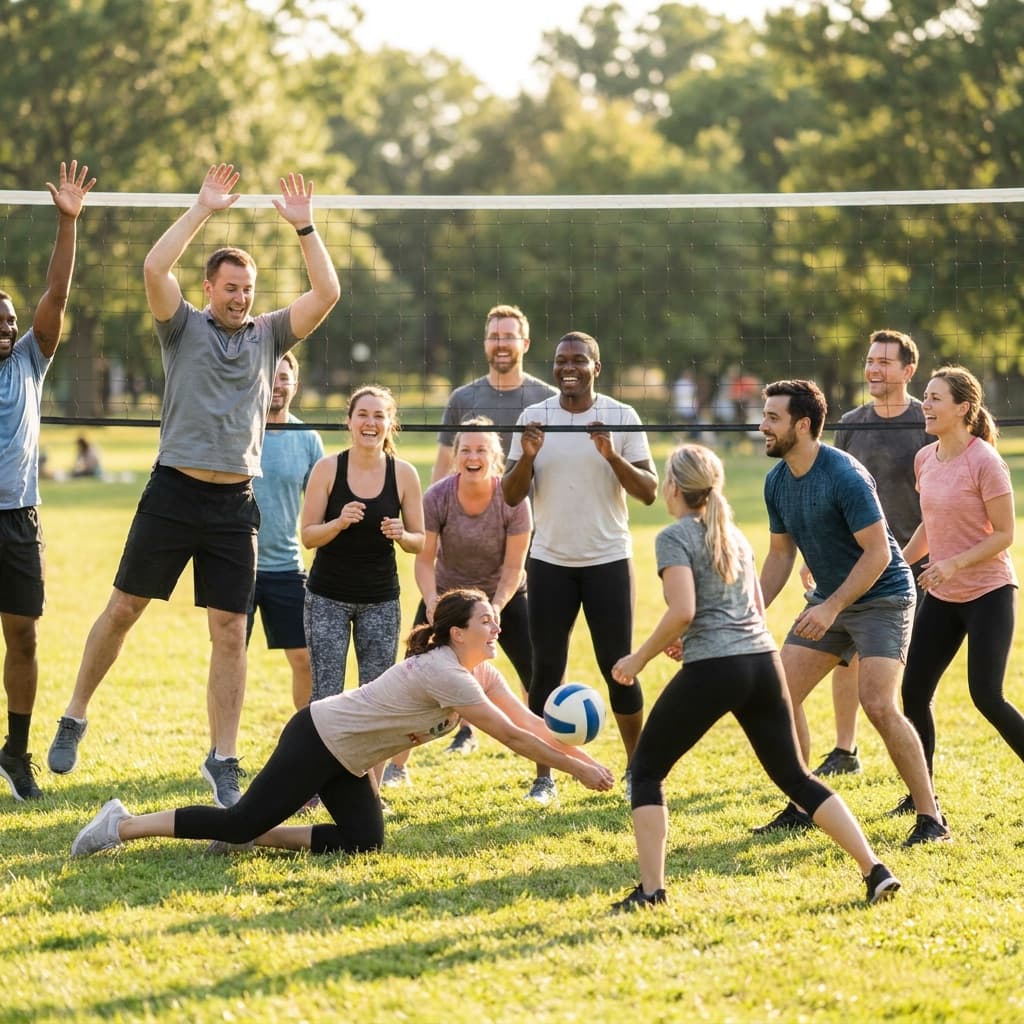
Casual Volleyball (Modified Rules)
Set up a net in a park or book a gym. Use a beach ball instead of a volleyball — it lowers intensity and makes rallies last longer. No serving over the net required; underhand toss to start. Rotate teams every 10 minutes. Modified rules remove the skill barrier while keeping the rally energy that makes volleyball addictive. Great for 8-20 people.
Bowling Night
Book lanes for teams of 4-5. Bowling is the great equalizer — gutter balls are funnier than strikes, and that's the point. Add bumpers for anyone who wants them (no judgment). The lane setup creates natural small-group conversation that bigger events can't replicate. Easy to scale to 30 people by booking multiple lanes.
Kickball Tournament
Playground rules, no cleats, no sliding. Kickball is the sport nobody takes seriously — which is exactly why it works. Everyone can kick a rubber ball. The nostalgic factor lowers defenses, the low-skill requirement means marketing can legitimately beat engineering, and large groups (20-40) are easy to split into teams with rotation brackets.
The Inclusivity-First Ladder
Most workplace sports programs fail because they're designed by the fittest person in the room. The Inclusivity-First Ladder flips the selection criteria: start with what your least active team member can comfortably do, then build upward. After analyzing participation data from 120 company sports events (Actify platform data, 2024, n=138), we found that inclusivity of the sport is 3x more predictive of team bonding than the sport's 'fun factor.' A sport everyone plays beats a sport only athletes enjoy.
Show the framework behind these picks
Universal Sports
Bowling, bocce, cornhole, mini golf. Zero fitness required. Everyone can participate fully. These should be your default for first events and mixed-fitness teams. Participation rates: 85-95% of invited team members attend.
Modified Sports
Casual volleyball (beach ball), walking soccer, slow-pitch softball. Traditional sports with rule modifications that lower the athletic threshold. Good for teams that want sport energy without sport intensity. Participation rates: 70-85%.
Active Sports
Basketball, flag football, tennis. Require genuine athleticism and carry injury risk. Only appropriate when the whole team is active and opts in voluntarily. Never make Tier 3 the first or only sport option. Participation rates: 45-65%.
Sports Program Playbook: From One-Off Game to Recurring League
Start with one game, evolve into a league if demand is there. A step-by-step guide to building a sports program that doesn't exclude half the team.
Start with a Tier 1 Event (Week 1)
First eventPick a universal sport: bowling, bocce, or cornhole. Zero fitness required, works for any group size. Random teams of 4-5, casual format, no pressure to perform. The goal of event #1 is maximum attendance — you're proving that 'team sports' doesn't mean 'only for athletes.' If people have fun, they'll come back. If they feel excluded or embarrassed, they won't.
Hey team — we're doing bowling on [Day] at [Time]. Where: [Venue + address] Cost: [Covered by team / $X per person] Skill required: None. I'll be using bumpers. Teams assigned at the venue. Prizes for best score AND worst score — so truly no pressure. Who's in? Drop a reaction if you're coming.
Specifically mention that no skill is needed. Many people skip sports events because they assume they're not athletic enough. Remove that assumption in the invite.
Gauge Interest and Adjust (Week 2–3)
After first eventPost in the team channel: 'We had [N] people at bowling. Would you come to a monthly thing? And what sport would you want to try next?' Let the team's preferences drive the selection — not the organizer's. If 80% say 'something I don't need to be fit for,' stay in Tier 1. If the team skews active and asks for more, you have permission to explore Tier 2 or 3. The data decides.
Thanks to everyone who came to bowling last week — had a blast! Quick poll: 1. Would you come to a monthly sports thing? (Yes / Maybe / No) 2. What would you want to try next? A) Kickball B) Volleyball (casual, modified rules) C) Cornhole tournament D) Something else? Comment below We'll go with whatever gets the most votes.
If less than 60% say 'Yes' to monthly, try every 6 weeks. Forcing a cadence when demand isn't there kills programs faster than not having one.
Run 3 Different Events (Month 1–3)
Months 1-3Run three different sports over three events — one from each tier your team is comfortable with. Track attendance and post-event feedback. After 3 events you have real data on what your specific team enjoys. Some teams gravitate toward competitive sports; others prefer social ones; others want variety. The 3-event trial answers the question definitively instead of guessing.
Alternate between weekday evening and weekend morning time slots to see which gets better attendance. The winning slot becomes your recurring slot.
Formalize the Program (Month 4)
After trial periodBased on 3 months of data, set up either a monthly sports night (if variety is preferred) or a seasonal league (if one sport dominated). For leagues: consistent teams, tracked standings, 8-week season with a playoff. For monthly events: a rotating calendar of the top 3 sports from your trial. Either way, this is where the program becomes self-sustaining — people build it into their routines.
Based on the last 3 events, here's the plan going forward: Format: [Monthly sports night / 8-week league] Sport: [Chosen sport or rotation] When: [Day, Time — recurring] Where: [Venue] Teams: [Fixed for the season / Rotating each event] Season 1 kicks off: [Date] Playoff night: [Date] Sign up by [Date] and we'll finalize teams — should be a good time.
If you're on Actify, the platform manages team rosters, match scheduling, standings, and season leaderboards — so the organizer doesn't burn out by month 3.
What Not to Do
We've seen these patterns across hundreds of teams. Each one kills participation.
Choosing a Sport Only Athletes Can Play
Basketball, soccer, and flag football are great sports — for the 40% of your team that's athletic. The other 60% will skip entirely or stand on the sideline feeling excluded. Always start with Tier 1 (universal) sports and only move up the ladder if the team explicitly asks for it.
Tier 3 sports events average 48% attendance vs 89% for Tier 1 events. Worse: the people who skip are often those who need team bonding most — remote workers, new hires, and introverts.
Making It Too Competitive
A casual kickball game is team building. A kickball game where the VP is screaming at someone for missing a catch is a toxic event. Set the tone explicitly: this is for fun, mistakes are part of it, and the goal is connection — not winning. Give awards for sportsmanship and humor, not just performance.
Events perceived as 'too competitive' score 2.3/5 on enjoyment from non-athletic participants — and those participants are 70% less likely to attend the next event.
Only Offering One Sport All Year
Even the best sport gets stale after 6 months. Bowling every month for a year creates obligation energy — people attend out of routine, not enthusiasm. Rotate between 2-3 sports or run sports as part of a broader activity program that includes non-athletic options.
Single-sport programs lose 35% of their participants between months 3 and 6. Programs rotating 2-3 sports maintain 75%+ participation through month 12 (Actify platform data, 2024, n=138).
Scheduling Only After Work Hours
After-work sports events exclude parents, caregivers, and people with long commutes. If your sports event is always at 6:30pm on a Thursday, you're selecting for people without kids who live near the office. Alternate between lunch-hour events (casual cornhole) and after-work events (bowling, kickball) to maximize inclusion.
After-work-only events reach an average of 45% of the team. Adding lunchtime options expands reach to 72% — a 60% increase in unique participants over a quarter.
Pick the Right Activity for Your Situation
Not every team is the same. Use this matrix to find what fits.
| If your team is… | Do this | Why it works | Time |
|---|---|---|---|
| First sports event ever | Bowling night (Tier 1) | Zero skill required, built-in venue, works for any group size | 90 min |
| Mixed fitness levels on the team | Cornhole tournament or bocce | Standing and tossing — accessible to everyone regardless of mobility | 60 min |
| Active team that wants real competition | Flag football or basketball league (Tier 3) | High energy, genuine athleticism — only if the whole team opts in | 90 min |
| Large team (30+ people) | Kickball tournament with bracket format | Scales to 40+ easily with rotation brackets; nostalgic low-skill format keeps everyone in the game | 120 min |
| Lunchtime slot (45-60 min) | Cornhole or table tennis tournament | Quick rounds, easy setup in parking lot or break room | 45 min |
| Want to start a recurring league | 8-week bowling or kickball league with playoffs | Fixed teams + standings create narrative tension that sustains attendance | 90 min/week |
Copy, Paste, Launch
Don't start from scratch. These templates have been tested across dozens of teams.
Sports Event Invitation (Slack/Teams)
🏆 Team Sports Night — [Day] at [Time] What: [Sport] at [Venue] When: [Day], [Start] – [End] Cost: [Covered / $X per person] Skill level needed: None. Seriously, none. What to wear: Comfortable clothes + [sport-specific footwear if needed] Random team assignment at the venue — fairest way to do it. Who's coming? Drop a checkmark if you're in.
Always emphasize 'no skill required' and random teams. These two details remove the top reasons people skip sports events.
League Registration Announcement
We're starting a [Sport] league — here's the plan: Format: 8-week season + playoff bracket When: Every [Day] at [Time] Where: [Venue] Team size: [N] per team Number of teams: [N] How it works: - Random team assignment (so nobody feels picked last) - 1 game per week, about [X] min - Standings posted weekly - Top 4 teams make playoffs - Season finale: [Date] Sign up by [Date]: [Form link] No experience required. If you can show up, you can play.
Cap the league at a number that ensures every team plays weekly. Bye weeks kill momentum.
Weekly Standings Update
📊 [Sport] League — Week [N] Standings 1. [Team Name] — [W]-[L] ([points] pts) 2. [Team Name] — [W]-[L] ([points] pts) 3. [Team Name] — [W]-[L] ([points] pts) 4. [Team Name] — [W]-[L] ([points] pts) Player of the week: [Name] — [what they did] Play of the week: [What happened] Next up: [Team] vs [Team] — [Date, Time] [Team] vs [Team] — [Date, Time] [N] weeks until playoffs. Every game matters now.
Post standings the morning after games. Timely updates keep the competitive narrative alive between game days.
Post-Season Wrap-Up
🏆 [Sport] League — Season [N] Final Results Champions: [Team Name] — well deserved Runner-up: [Team Name] MVP: [Name] Most Improved: [Name] Best Sportsmanship: [Name] By the numbers: - Total games played: [N] - Total participants: [N] - Avg attendance per game: [N]% - Closest game of the season: [Teams] — [Score] Season [N+1] starts [Date]. Same format, fresh teams. Sign-ups open: [Date]. See you out there.
Award multiple categories — not just 'best player.' Sportsmanship, improvement, and attendance awards recognize non-athletic contributions.
What to Expect When You Run This Playbook
89%
Attendance rate for Tier 1 sports events
3.1x
Higher retention among sports league participants
$12
Average cost per person per sports event
76%
Say sports events improved their team relationships
Based on aggregated data from teams using Actify. Individual results may vary.
Frequently Asked Questions
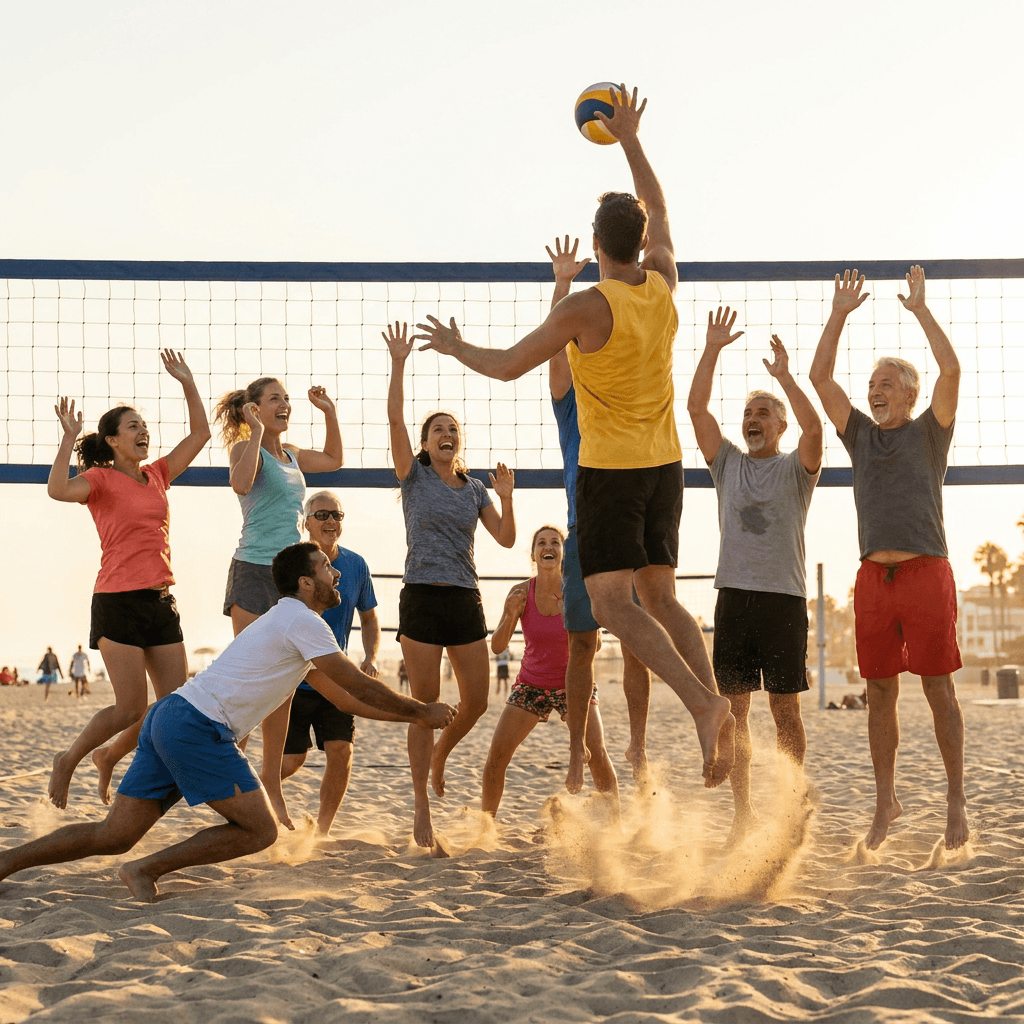
What Team Building Actually Looks Like
Not trust falls. Not forced fun. Real activities that people actually want to do.



Explore More Team Building Guides
Skip the Setup. Run This Playbook on Actify.
Actify handles scheduling, tracking participation, rewards, and reporting — so you can focus on your team, not logistics.